Tag: wedding_rings

What Grooms Actually Get Wrong About Their Wedding Day Look

Most grooms spend weeks picking a suit. They compare shades of navy and charcoal, stress over lapel widths, and try on a dozen shirts. Then they throw the whole look together the morning of the wedding and realize something feels off. The suit is great. But the rest of the look wasn’t thought through. That disconnect is more common than you’d think. And the good news is that it’s very easy to fix.

The Suit Is Just the Start

A well-fitted suit will always do most of the heavy lifting. But styling doesn’t stop there. The pieces that sit around the suit — the shoes, the pocket square, the tie, and especially the ring — are what actually make a look feel complete. When those details line up, the whole outfit clicks into place. When they don’t, something always feels missing in photos.

What Grooms Actually Get Wrong About Their Wedding Day Look

The Ring Deserves More Thought than You’re Giving It

Here’s where a lot of grooms fall short. They spend months on every other part of the wedding and pick a ring in an afternoon. The ring is the one piece you’ll wear every day after the wedding. It should feel right on your hand and work with your personal style. A thick, matte tungsten band reads very differently from a polished gold ring. One might suit a minimalist wardrobe perfectly, while the other might clash with it completely. Spending time on wedding bands for men before the big day pays off in ways that go far beyond the ceremony. Think about metal tone, width, and finish relative to the watch you wear and the style of ring you’d actually reach for on a regular Tuesday.

Match Your Metal Tones

This one sounds small, but it makes a big difference. If your cufflinks are silver, your watch is silver, and your belt buckle is silver, a yellow gold ring will feel out of place. The same goes in reverse. You don’t need to be obsessive about it, but a general consistency in metal tones ties an outfit together without the viewer knowing exactly why. Rose gold, silver, black, and yellow gold all work well. Just be intentional about which direction you’re going.

What Grooms Actually Get Wrong About Their Wedding Day Look

Pocket Squares Are Not Optional

For a formal or semi-formal wedding, a pocket square is one of the easiest upgrades you can make. It adds color and depth to the chest area of your suit without requiring much effort. You don’t need to match it exactly to your tie. In fact, a slight contrast often looks better. A white linen fold is always clean and safe. A soft patterned square in a complementary color adds personality. Skip it only if the dress code is genuinely casual.

What Grooms Actually Get Wrong About Their Wedding Day Look

Shoes Set the Tone More Than People Realize

Brown suede derbies and black patent oxfords are very different statements. Neither is wrong, but each sends a different message about the formality of the occasion. For a black tie or very formal setting, a sleek black leather oxford is the right call. For a daytime garden or summer wedding, a brown leather loafer or derby in a warm tan shade feels more appropriate. Make sure your shoes are clean, polished, and broken in. Nothing derails a great suit faster than fresh-from-the-box shoes that squeak on the dance floor.

The Color Palette Matters as Much as the Cut

A lot of grooms default to the safest possible color option and end up looking a little flat. Navy, charcoal, and black are all excellent choices, but they work best when there’s at least one interesting element in the mix. That might be a patterned tie, a richer pocket square, or a subtle texture in the suit fabric. If you want to explore something with more character, there’s also growing interest in unconventional stone choices — the trend toward dark gemstone rings and non-traditional jewelry has been making its way into groom styling too, especially for couples who want their look to feel personal rather than generic. A dark stone ring against a charcoal suit can feel deeply intentional.

Fit Beats Everything Else

This point gets repeated often, but it doesn’t get repeated enough. A mid-range suit that fits perfectly will always look better than an expensive suit worn off the rack without alterations. The jacket should sit on your shoulders without pulling or sagging. The sleeves should show about half an inch of shirt cuff. The trousers should break cleanly at the shoe. If you haven’t had your suit tailored, that’s the single best investment you can make between now and the wedding.

Build the Full Look Early

Give yourself at least two weeks before the wedding to have the complete outfit assembled — suit, shirt, tie, pocket square, shoes, socks, cufflinks, and ring — and try it on together in good lighting. Ideally, take a photo. You’ll catch things you wouldn’t notice otherwise. A collar that gaps, a tie that’s too short, or a ring that clashes with a watch are all things that are very easy to fix with time but nearly impossible to fix the morning of the ceremony. For inspiration on how to bring different elements together, exploring men’s wedding outfit ideas that factor in venue, season, and dress code can help clarify which direction your look should go.

The Small Details Are the Whole Point

Wedding photos last a long time. The small details — the way a ring catches the light, the fold of a pocket square, the shine on a clean leather shoe — are what make those photos feel polished rather than just adequate. You don’t need to become a menswear obsessive overnight. You just need to think through the full picture, not just the suit on its own.
Dark Gemstone Rings: The Anti-Sparkle Trend Taking Over Jewelry This Season

Dark Gemstone Rings: The Anti-Sparkle Trend Taking Over Jewelry This Season

Not everyone wants a ring that catches the light from across the room. Some people want a ring that draws attention in a quieter way — one that feels deliberate, a little mysterious, and completely their own. That quiet appeal is helping dark gemstone jewelry move into everything from engagement ring searches to everyday stacking sets.

The anti-sparkle trend isn’t about rejecting beauty. It’s about redefining what beautiful looks like on your hand.

Why Dark Gemstones Feel Right Now

For a long time, the standard expectation around rings — especially engagement rings — followed a predictable script: clear stone, maximum brilliance, white metal. The script worked for a lot of people, and it still does. But a growing number of wearers have found themselves drawn to something with more weight to it, visually and symbolically.

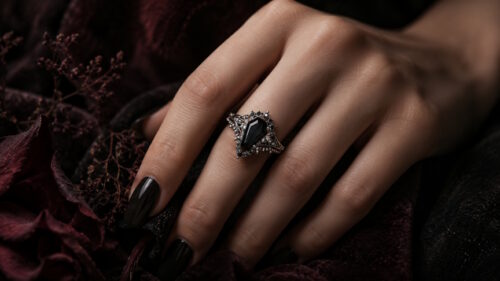
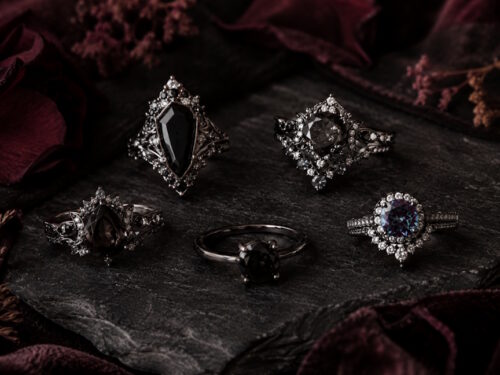
Dark gemstones carry a different kind of presence. They don’t perform for the room. A deep black onyx, a smoky rutilated quartz threaded with dark inclusions, or a midnight-toned stone in a gothic-inspired setting communicates something quieter and more intentional. It says the person wearing it thought carefully about what they wanted — and didn’t default to convention.

The broader shift toward alternative and non-traditional jewelry has been building for years, but it feels especially visible now. More independent jewelers are expanding their collections beyond traditional clear-stone designs, giving shoppers a wider range of black engagement rings, dark gemstones, and unconventional settings to consider. What was once a niche category now feels more developed, varied, and accessible.

The Dark Stones Defining the Look

Dark Gemstone Rings: The Anti-Sparkle Trend Taking Over Jewelry This Season

Black onyx is the most recognized of the dark gemstones making waves in jewelry right now. Its surface has an almost lacquer-like quality — smooth, opaque, and deeply black — that creates a dramatic contrast when set against white gold, yellow gold, or silver. It can also work for everyday wear with the right setting and care, which matters for anyone considering it as an engagement or commitment ring.

Coffin-cut stones have become particularly associated with the dark aesthetic. The six-sided cut, elongated and pointed at both ends, has a bold geometry that suits the moody, alternative character of dark jewelry better than many conventional shapes. Paired with black onyx or black rutilated quartz, a coffin cut produces a ring that reads as unmistakably intentional.

Black rutilated quartz takes things in a slightly different direction — it’s translucent rather than opaque, with dark needle-like inclusions running through the stone in patterns that are unique to each piece. No two are identical, which makes it appealing to the same buyers who gravitate toward moss agate for its organic, one-of-a-kind quality.

Beyond fully dark stones, contrast settings are also becoming part of the look: a dark center stone surrounded by bright moissanite or white lab-grown diamond side stones. The interplay between deep and bright creates something visually striking that neither stone could achieve alone.

How Designers Are Interpreting the Trend

The dark aesthetic isn’t limited to gothic or maximalist design — that’s one of the more interesting things about how it’s evolved. There are three broad directions it tends to take.

The first is the dramatic and sculptural approach: bold cuts, ornate metalwork, mixed stones, and settings that have a historical or theatrical quality. Think Victorian mourning jewelry reimagined for someone who wears it to a wedding rather than a funeral.

The second is the minimalist dark — a clean solitaire in a simple four-prong or bezel setting, where the stone’s depth does all the work. No flourishes, no extra stones. Just the quiet weight of the dark gem against a fine band.

The third, and perhaps the most wearable for a broad audience, is nature-inspired dark jewelry: leaf motifs, vine-shaped bands, twig details worked into the metalwork. This approach softens the darkness and grounds it in something organic and earthy. It’s particularly popular with buyers who also gravitate toward moss agate and other nature-adjacent stones.

Why Dark Stones Are Entering Engagement Ring Conversations

Choosing a dark gemstone for an engagement ring used to feel like a niche decision. It still turns heads — but increasingly in a way that draws admiration rather than confusion.

The symbolism associated with black stones has helped. Black onyx in particular carries meanings of strength, protection, and grounded commitment — qualities that resonate with couples who want their ring to mean something beyond aesthetics. It’s a different language for expressing love, and for some people it’s more honest than a traditional diamond.

Jewelers such as Romalar Jewelry have developed collections of dark statement rings that bring together coffin cuts, black onyx, and dark rutilated quartz in settings that range from nature-inspired to cleanly architectural — a sign of how broad the design vocabulary for this category has become.

For couples who want something that feels personal without straying into full gothic territory, dark stones also work beautifully within a wider ring selection. The range of gemstone engagement rings available today — spanning everything from pale moss agate to deep black onyx, with many cuts, metals, and setting styles — means dark and light can coexist, or a couple can each choose something that speaks to their individual taste while still feeling cohesive.

What to Know Before Choosing a Dark Stone

Dark gemstones vary considerably in hardness and durability. Black onyx scores a 6.5 to 7 on the Mohs hardness scale, which is softer than moissanite or sapphire. It holds up well to everyday wear but benefits from a protective setting — a bezel that wraps around the stone’s edges offers more protection than exposed prongs, particularly for active wearers.

Because dark stones are opaque, clarity grading doesn’t apply in the same way it does for transparent gems. What you’re evaluating instead is surface polish and consistency of color. A well-polished black onyx should have an even, deep tone without visible patchiness or dullness. This is worth examining in person or through detailed photography if buying online.

For anyone drawn to coffin or other pointed cuts, checking that the point is securely set is important. Sharp corners are the most vulnerable part of any faceted stone, and a protective metal tip or a V-prong setting goes a long way.

What the Anti-Sparkle Trend Says About Personal Style

The rise of dark gemstone rings is part of something larger happening in how people relate to jewelry. The idea that fine jewelry should be universally legible — that a ring has to announce itself in conventional terms to count as serious or meaningful — has lost a lot of its authority.

What’s replacing it is something more personal. Wearers are asking what a piece means to them, how it reflects who they actually are, and whether it feels like theirs. For people whose instincts run toward the atmospheric, the unconventional, or the quietly dramatic, dark gemstone rings offer exactly that kind of resonance.

The anti-sparkle look is not going anywhere. If anything, it is becoming one of the most distinctive ways to make a ring feel personal.