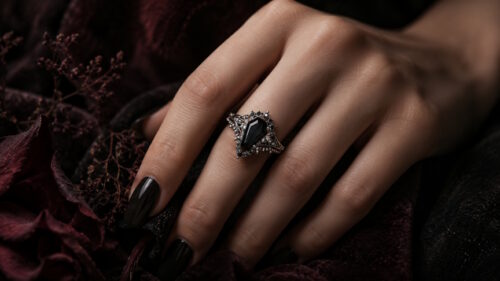
Not everyone wants a ring that catches the light from across the room. Some people want a ring that draws attention in a quieter way — one that feels deliberate, a little mysterious, and completely their own. That quiet appeal is helping dark gemstone jewelry move into everything from engagement ring searches to everyday stacking sets.
The anti-sparkle trend isn’t about rejecting beauty. It’s about redefining what beautiful looks like on your hand.
Why Dark Gemstones Feel Right Now
For a long time, the standard expectation around rings — especially engagement rings — followed a predictable script: clear stone, maximum brilliance, white metal. The script worked for a lot of people, and it still does. But a growing number of wearers have found themselves drawn to something with more weight to it, visually and symbolically.
Dark gemstones carry a different kind of presence. They don’t perform for the room. A deep black onyx, a smoky rutilated quartz threaded with dark inclusions, or a midnight-toned stone in a gothic-inspired setting communicates something quieter and more intentional. It says the person wearing it thought carefully about what they wanted — and didn’t default to convention.
The broader shift toward alternative and non-traditional jewelry has been building for years, but it feels especially visible now. More independent jewelers are expanding their collections beyond traditional clear-stone designs, giving shoppers a wider range of black engagement rings, dark gemstones, and unconventional settings to consider. What was once a niche category now feels more developed, varied, and accessible.
The Dark Stones Defining the Look
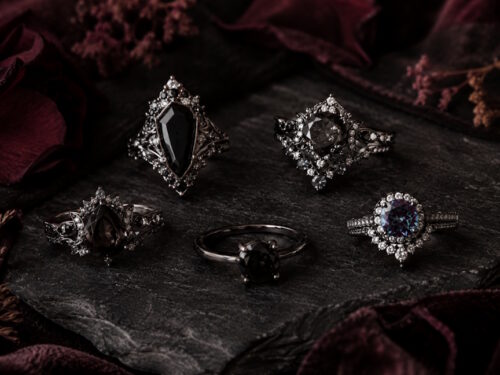
Black onyx is the most recognized of the dark gemstones making waves in jewelry right now. Its surface has an almost lacquer-like quality — smooth, opaque, and deeply black — that creates a dramatic contrast when set against white gold, yellow gold, or silver. It can also work for everyday wear with the right setting and care, which matters for anyone considering it as an engagement or commitment ring.
Coffin-cut stones have become particularly associated with the dark aesthetic. The six-sided cut, elongated and pointed at both ends, has a bold geometry that suits the moody, alternative character of dark jewelry better than many conventional shapes. Paired with black onyx or black rutilated quartz, a coffin cut produces a ring that reads as unmistakably intentional.
Black rutilated quartz takes things in a slightly different direction — it’s translucent rather than opaque, with dark needle-like inclusions running through the stone in patterns that are unique to each piece. No two are identical, which makes it appealing to the same buyers who gravitate toward moss agate for its organic, one-of-a-kind quality.
Beyond fully dark stones, contrast settings are also becoming part of the look: a dark center stone surrounded by bright moissanite or white lab-grown diamond side stones. The interplay between deep and bright creates something visually striking that neither stone could achieve alone.
How Designers Are Interpreting the Trend
The dark aesthetic isn’t limited to gothic or maximalist design — that’s one of the more interesting things about how it’s evolved. There are three broad directions it tends to take.
The first is the dramatic and sculptural approach: bold cuts, ornate metalwork, mixed stones, and settings that have a historical or theatrical quality. Think Victorian mourning jewelry reimagined for someone who wears it to a wedding rather than a funeral.
The second is the minimalist dark — a clean solitaire in a simple four-prong or bezel setting, where the stone’s depth does all the work. No flourishes, no extra stones. Just the quiet weight of the dark gem against a fine band.
The third, and perhaps the most wearable for a broad audience, is nature-inspired dark jewelry: leaf motifs, vine-shaped bands, twig details worked into the metalwork. This approach softens the darkness and grounds it in something organic and earthy. It’s particularly popular with buyers who also gravitate toward moss agate and other nature-adjacent stones.
Why Dark Stones Are Entering Engagement Ring Conversations
Choosing a dark gemstone for an engagement ring used to feel like a niche decision. It still turns heads — but increasingly in a way that draws admiration rather than confusion.
The symbolism associated with black stones has helped. Black onyx in particular carries meanings of strength, protection, and grounded commitment — qualities that resonate with couples who want their ring to mean something beyond aesthetics. It’s a different language for expressing love, and for some people it’s more honest than a traditional diamond.
Jewelers such as Romalar Jewelry have developed collections of dark statement rings that bring together coffin cuts, black onyx, and dark rutilated quartz in settings that range from nature-inspired to cleanly architectural — a sign of how broad the design vocabulary for this category has become.
For couples who want something that feels personal without straying into full gothic territory, dark stones also work beautifully within a wider ring selection. The range of gemstone engagement rings available today — spanning everything from pale moss agate to deep black onyx, with many cuts, metals, and setting styles — means dark and light can coexist, or a couple can each choose something that speaks to their individual taste while still feeling cohesive.
What to Know Before Choosing a Dark Stone
Dark gemstones vary considerably in hardness and durability. Black onyx scores a 6.5 to 7 on the Mohs hardness scale, which is softer than moissanite or sapphire. It holds up well to everyday wear but benefits from a protective setting — a bezel that wraps around the stone’s edges offers more protection than exposed prongs, particularly for active wearers.
Because dark stones are opaque, clarity grading doesn’t apply in the same way it does for transparent gems. What you’re evaluating instead is surface polish and consistency of color. A well-polished black onyx should have an even, deep tone without visible patchiness or dullness. This is worth examining in person or through detailed photography if buying online.
For anyone drawn to coffin or other pointed cuts, checking that the point is securely set is important. Sharp corners are the most vulnerable part of any faceted stone, and a protective metal tip or a V-prong setting goes a long way.
What the Anti-Sparkle Trend Says About Personal Style
The rise of dark gemstone rings is part of something larger happening in how people relate to jewelry. The idea that fine jewelry should be universally legible — that a ring has to announce itself in conventional terms to count as serious or meaningful — has lost a lot of its authority.
What’s replacing it is something more personal. Wearers are asking what a piece means to them, how it reflects who they actually are, and whether it feels like theirs. For people whose instincts run toward the atmospheric, the unconventional, or the quietly dramatic, dark gemstone rings offer exactly that kind of resonance.
The anti-sparkle look is not going anywhere. If anything, it is becoming one of the most distinctive ways to make a ring feel personal.